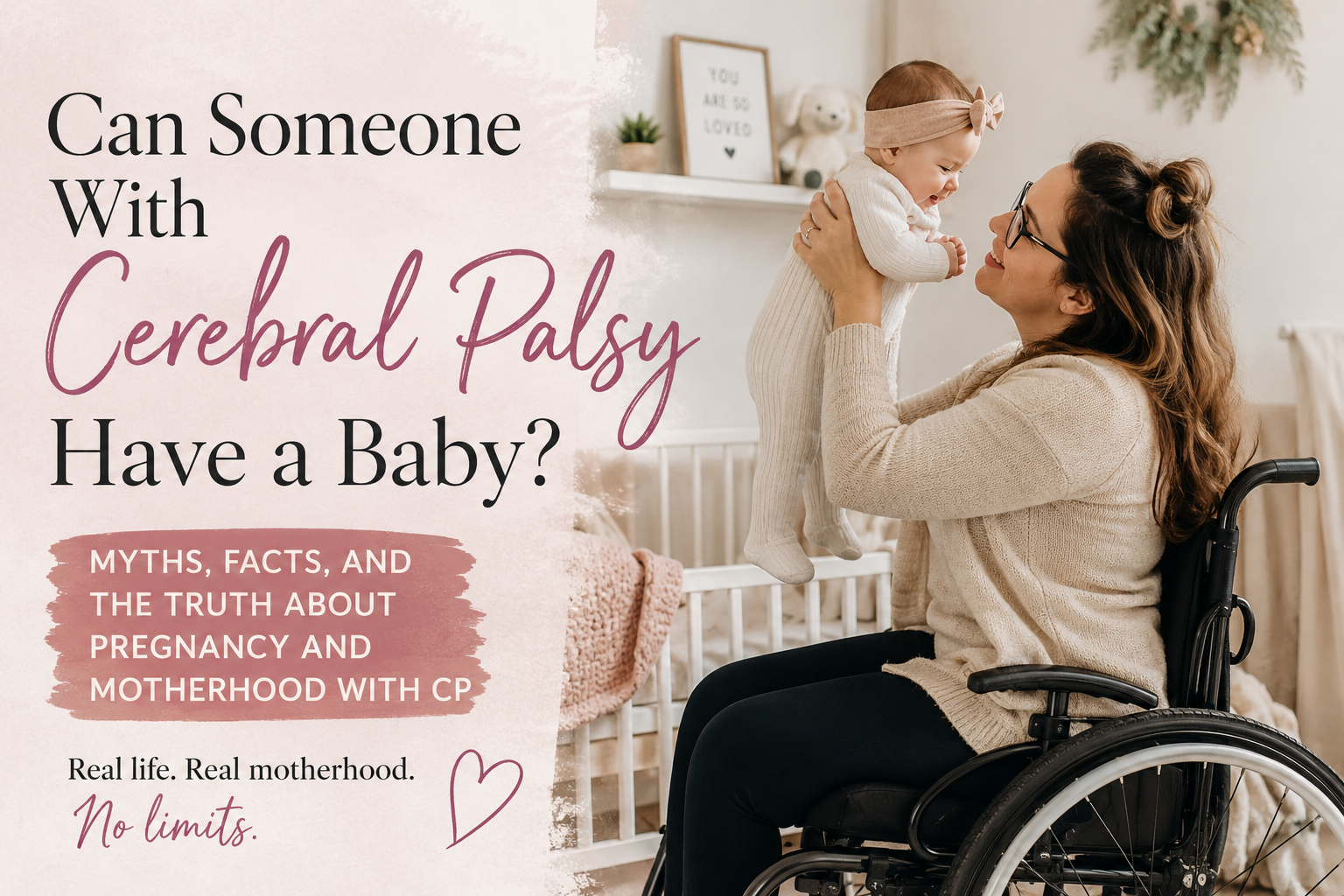

Most little girls dream of one day becoming a mom.
They watch their own mothers and copy their selfless actions without even realizing it — showering slobbery kisses all over their dolls and sometimes even the family dog.
But when you grow up with a disability like Cerebral Palsy, motherhood can start to feel less like an expectation and more like a question mark.
And eventually, for many women with CP, that question becomes personal:
Can someone with Cerebral Palsy have a baby?
Yes. Many women with cerebral palsy go on to have healthy pregnancies, healthy babies, and beautiful experiences with motherhood.
Common Myths About Cerebral Palsy and Pregnancy
Society has long pushed harmful and untrue assumptions about disabled motherhood.
And after hearing those messages enough, it becomes easy to internalize the stereotypes and wonder whether motherhood with Cerebral Palsy — or any lifelong disability — somehow disqualifies you from carrying and raising a child.
But that simply isn’t true.
Unfortunately, ableist attitudes surrounding disability and motherhood have existed for centuries in the United States and many other countries around the world.
Truthfully, it wasn’t all that long ago that disabled women were discouraged from marrying or starting families at all. Some were even forcibly sterilized because society viewed their bodies as “wrong,” “incapable,” or burdensome to others.
And yet, here we are.
Despite the growing narrative that “all bodies are good,” disabled mothers are still often shamed, questioned, and isolated for choosing to raise a family.
In fact, one of the most common search queries surrounding disabled motherhood is still:
Can someone with CP have a baby?
That question alone says a lot about how society continues to view disability, womanhood, and motherhood.
Myth #1: Women With Cerebral Palsy Can’t Get Pregnant
One of the most common misconceptions surrounding motherhood with CP is the belief that women with Cerebral Palsy cannot get pregnant at all.
However, there is no scientific evidence suggesting that Cerebral Palsy directly affects fertility.
Many women with CP go on to have healthy pregnancies, healthy babies, and full experiences with motherhood.
While some women with disabilities may face additional medical challenges during pregnancy, disability alone does not automatically prevent someone from becoming a mother.
Myth #2: If I Have CP, My Baby Will Too
Another major fear surrounding pregnancy with Cerebral Palsy is the assumption that CP is always passed down genetically to children.
But in most cases, Cerebral Palsy is not an inherited condition.
Instead, CP is often caused by injury to the developing brain before, during, or shortly after birth. This can happen for many reasons, including complications during pregnancy or delivery, lack of oxygen at birth, infections, premature birth, or brain injury in infancy.
According to Cerebral Palsy Guide, up to 70% of Cerebral Palsy cases are linked to factors occurring before or during birth rather than inherited genetics.
Myth #3: Pregnancy With Cerebral Palsy Is Impossible or Always Dangerous
Every woman experiences pregnancy differently — and that includes women with disabilities.
Some women with CP may experience additional fatigue, pain, muscle tightness, balance difficulties, or mobility challenges during pregnancy. Others may have relatively uncomplicated pregnancies.
But pregnancy with Cerebral Palsy is not automatically unsafe or impossible.
In many ways, disabled women are treated as though pregnancy itself is shocking or irresponsible simply because their bodies look or function differently.
And while some women with CP may require additional monitoring or support from their medical team, disability alone does not make someone incapable of carrying a healthy pregnancy.
Women with Cerebral Palsy become mothers every day.
Myth #4: Women With Cerebral Palsy Can’t Care for Children
One of the most hurtful misconceptions surrounding disabled motherhood is the assumption that women with disabilities are incapable of safely raising children.
But parenting has never looked exactly the same for everyone.
Some mothers breastfeed while others formula feed. Some stay home while others work. Some rely heavily on family support while others parent more independently.
Motherhood is not one-size-fits-all — and disability does not erase someone’s ability to love, nurture, protect, and raise a child.
Yes, parenting with Cerebral Palsy may require adaptations. Some disabled mothers modify routines, ask for help more often, or find creative ways to navigate physically demanding tasks.
But adaptation is not failure.
In fact, all parents adapt constantly. Disabled mothers are simply more aware of it because society tends to scrutinize them more closely.
And truthfully, raising children has made me more resourceful, resilient, and confident in my own abilities than I ever expected.
Myth #5: Disabled Women Shouldn’t Have Children
This is perhaps the ugliest misconception of them all — even when it’s left unspoken.
For generations, disabled women were made to feel as though motherhood was irresponsible, unrealistic, or selfish. And while society has made progress, traces of those beliefs still exist today.
People may not always say it directly, but disabled mothers are often questioned in ways non-disabled mothers are not.
Can you handle it?
Who helps you?
What if your child has your disability?
Why would you choose this?
But disabled people are just that — people.
People who fall in love.
People who build families.
People who dream about motherhood long before they ever become mothers.
Having a disability does not make someone less deserving of love, marriage, pregnancy, or children.
And perhaps the most ironic part of all is this:
Many disabled mothers spend their lives being told what they supposedly cannot do — only to become mothers and do it anyway.
Final Thoughts on Pregnancy and Motherhood With Cerebral Palsy
So, can someone with Cerebral Palsy have a baby?
Absolutely.
Women with CP can and do become loving, capable, successful mothers every single day.
That does not mean pregnancy or parenting with a disability is always easy. There may be additional challenges, limitations, fears, or physical demands along the way.
But motherhood was never meant to belong only to people with perfect bodies.
Disabled motherhood exists.
Disabled motherhood matters.
And disabled mothers deserve the same respect, support, dignity, and encouragement as anyone else raising children.
If you’re a woman with Cerebral Palsy wondering whether motherhood is possible for you, let this be your reminder:
Your disability does not disqualify you from building a beautiful life or a beautiful family.
Leave a Reply