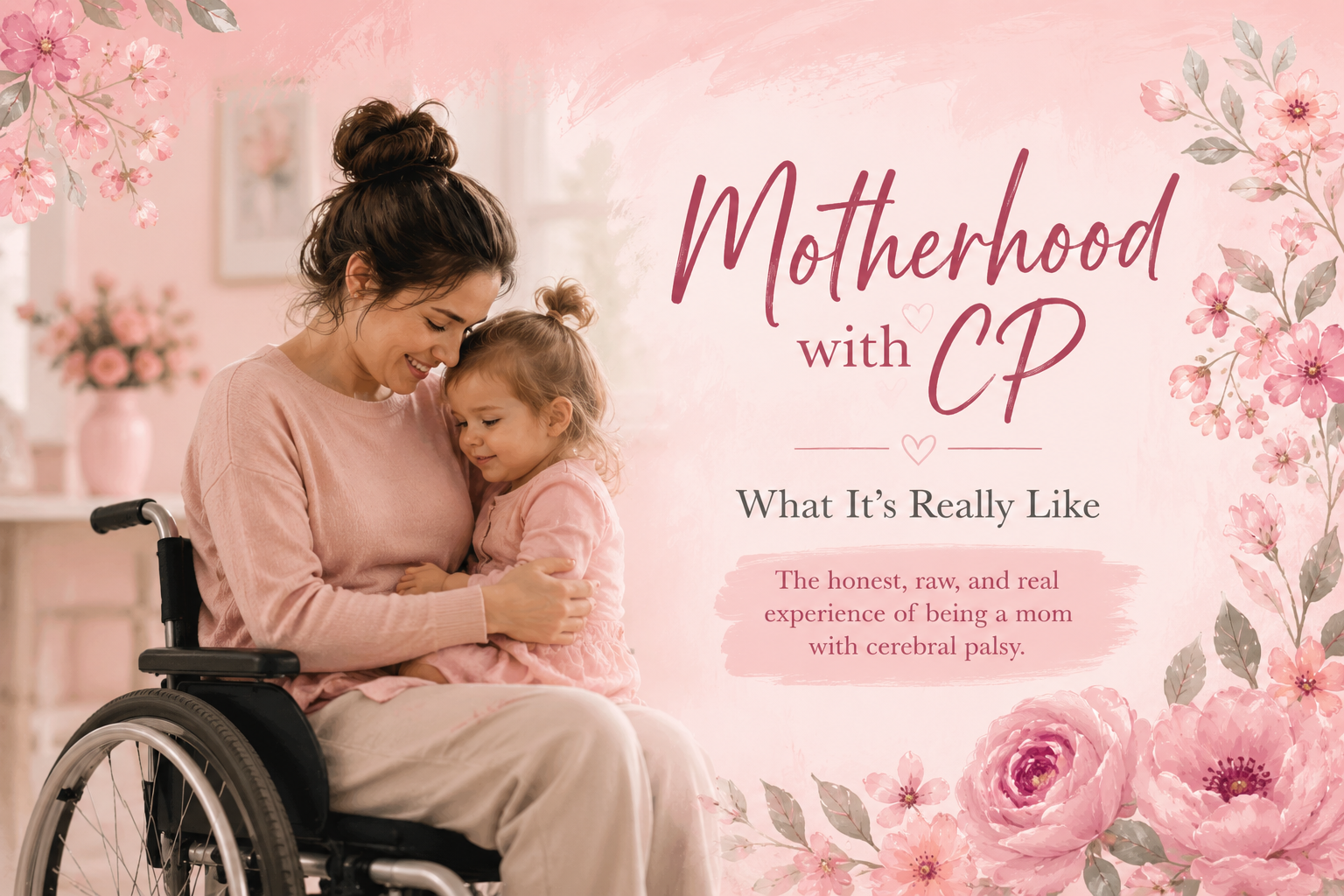

I’ve spent a lot of time thinking about motherhood and how disability has shaped every part of mine. And as I’ve shared my experiences, I’ve found myself wondering: if you live with CP, you probably already understand. But how do I explain to others the reality of parenting with a disability and navigating motherhood with CP?
This is my experience.
I hope you’ll follow along.
❀ ───────── ❀
Cerebral palsy has been my constant companion for 30 years.
The rude looks and comments, the curious-but-telling smiles, and the polite-but-not-so-subtle questions—I’ve seen it all. I’ve lived it, too.
As I’ve gotten older, I’ve learned to expect it, ignore it, or pretend it doesn’t hurt. Because sometimes that feels easier than drawing attention to something that has always felt like my fault. Or something I should somehow be able to control.
Whether I admitted it or not, CP was never just a diagnosis to me. For a long time, it felt more like a life sentence.
And honestly, I wasn’t always most concerned with my slower pace, my off-kilter balance, or the sway in my walk. What hurt more was what cerebral palsy seemed to say about me.
About who I could become.
My worth.
My likability.
My value.
The sad—but honest—truth is that people can be shallow enough to define someone by something that happened to them.
My experience as a woman with mild cerebral palsy has taught me far more about the limitations people assume about me than the limitations I’ve actually found in myself.
But life has a way of reshaping the story you think you’re living.
And for me, that shift came through motherhood.
Becoming a mom with cerebral palsy forced me to confront insecurities I thought I had already made peace with.
Because motherhood with CP doesn’t wait for you to feel ready. And it certainly doesn’t care about the assumptions people have made about your body.
It simply asks you to show up.
CP and Motherhood
Despite the challenges of living with cerebral palsy, there has never been much I truly believed I couldn’t do—or at least wouldn’t try.
At the same time, I’ve also learned there are days when I genuinely can’t do everything I want to.
That’s the complicated reality of cerebral palsy.
Living with CP is not one fixed experience. It shifts constantly. Some days I move through life without thinking much about it at all. Other days, I feel it in nearly everything I do.
As a child, classmates would ask questions I secretly wished I didn’t have to answer:
“Does it hurt?”
“Why do you walk that way?”
“Are you ever going to get better?”
At the time, I didn’t always have the words to explain my disability—or how those questions made me feel. Eventually, I learned how to move past moments like that.
But they stayed with me in another way.
Not because of the questions themselves, but because of what they revealed: people immediately notice that I am different.
And over time, I’ve learned that cerebral palsy is not one fixed feeling.
It doesn’t look the same every day, and it doesn’t affect me the same way all the time.
Some days it feels like my legs are half asleep in a way I can’t fully shake—as if I’m moving through something slightly heavier and slower than everyone else around me. I’m not stuck, but I’m not exactly quick either. Everything requires more intention.
Other days, it’s my back aching or my balance feeling off, like my body and brain simply are not syncing the way I expect them to.
And then there are the hardest days to explain.
The days where I wake up already exhausted.
The days where the energy I need feels gone before the morning even really begins. And with that exhaustion comes something deeper than physical fatigue. It becomes mental, too.
It’s the frustration of losing motivation before your day has even had the chance to settle in.
That’s the part of disabled parenting people don’t always see.
It’s not just that movement looks different.
It’s the unpredictability of living in a body that doesn’t always feel consistent.
And that unpredictability can be exhausting in a way that’s difficult to explain unless you’ve lived it yourself.
Becoming a Mom With Cerebral Palsy
Before becoming a mother, I worried more about what cerebral palsy looked like to other people than what it actually felt like to live with.
I worried about being judged because of my disability. About whether people would question my ability to parent before they ever gave me the chance.
And the truth is, some people probably did.
There is still this quiet assumption in the world that disabled motherhood is somehow less capable, less stable, or more difficult for the people around us.
But motherhood has a way of stripping life down to what actually matters.
Because when your child reaches for you, they are not thinking about your gait, your balance, or how fast you move.
They just know you are mom.
They know your comfort.
Your voice.
Your presence.
Your love.
Motherhood didn’t make me forget my disability.
It made me realize how little it ever defined me in the first place.
That doesn’t mean parenting with a disability is easy.
There are moments that physically exhaust me more quickly than they might for someone else. Days where carrying my child, navigating outings, or simply keeping up leaves my body aching by the end of the day.
Sometimes I have to move slower. Sometimes I need help. Sometimes I have to give myself more grace than I want to.
But being a CP mom has also taught me resilience in ways I never expected.
It has taught me that strength is not always loud or obvious. Sometimes strength looks like continuing to show up even when your body feels heavy. Sometimes it looks like adapting instead of giving up.
And sometimes it looks like letting your children see that different does not mean incapable.
The invisible parts of disabled parenting
One of the hardest parts of motherhood with CP is the invisible mental weight that can come with it.
Not just the physical exhaustion, but the pressure to constantly prove yourself.
To prove that you are capable.
Present.
Enough.
There are moments where I overthink things other parents may never have to consider.
Will people assume I can’t handle this?
Will they see my disability before they see me as a mother?
Will my child eventually notice the things I’ve spent years trying to hide?
But children have a beautiful way of seeing people without the layers the world adds.
My child does not see me as broken.
And maybe that’s one of the greatest gifts motherhood has given me.
Because while the world taught me to focus on what my body struggled to do, motherhood has taught me to focus on everything it still can.
What Motherhood With CP Has Taught Me
Motherhood with CP has taught me that love does not require perfection.
It has taught me that being a good mother has far less to do with how your body moves and far more to do with how you show up.
Patiently.
Consistently.
Lovingly.
Living with cerebral palsy can be exhausting, frustrating, and unpredictable. But it has also made me more adaptable, more empathetic, and more aware of the strength that exists in simply continuing forward.
And if you are navigating motherhood with CP, parenting with a disability, or learning how to embrace life as a disabled mom, I hope you know this:
Your children do not need perfection from you.
They need you.
Leave a Reply